


Time Under Tension Training Plan: 4 TUT Exercises
Fitness Tips
Nov 12, 2026 • 9min read
When you’re new to strength training, it’s easy to focus on how much weight you’re lifting or how many reps you can do.
But how you perform those reps matters, too. A time under tension workout shifts the focus to control, tempo and how long your muscles work.
Time under tension (TUT) can help seasoned gym-goers slow down, pay closer attention to form and build confidence with strength exercises. Instead of racing through a set, you deliberately control each phase of the movement.
Here’s how time-under-tension training works and how you can add it to your routine.
WHAT IS TIME UNDER TENSION (TUT)?
Time under tension is how long a muscle remains under load during an exercise or set. While reps measure how many times you complete a movement, TUT looks at how long your muscles are actively working.
Increasing time under tension can make familiar strength exercises more challenging, even when you use the same weight or less resistance. For example, during a squat, you might lower for three seconds and add a one-second pause at the bottom. That keeps your muscles working longer during each rep.
How does time under tension work? Changing your exercise tempo changes how long your muscles remain under load. Slowing the eccentric phase or adding a controlled pause can increase TUT without requiring you to add more weight.
THE THREE PHASES OF TIME UNDER TENSION
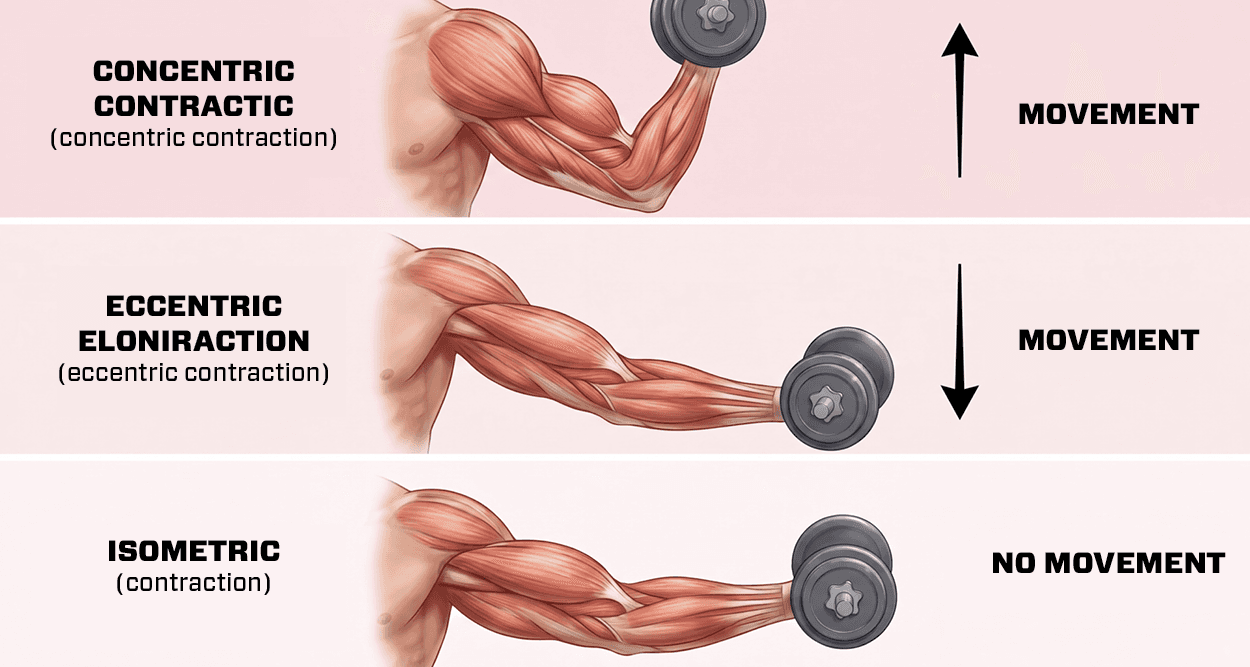
Most strength exercises involve three types of muscle contraction: eccentric, isometric and concentric. Understanding each phase can help you maintain a more controlled tempo throughout a rep.
Eccentric Contraction
Slowing the eccentric phase is one of the easiest ways to increase TUT. An eccentric contraction is when your muscle lengthens while under load. Examples include lowering your body into a squat or lowering the dumbbell to your side during bicep curls.
Isometric Contraction
Isometric training is when a muscle produces tension without significantly changing length. In other words, you hold the position. An isometric hold might mean pausing briefly at the bottom of a squat or holding a dumbbell midway through a curl.
Concentric Contraction
Concentric training is when a muscle shortens while under load, generally during the lifting, pushing or pulling portion of an exercise.
Examples of a concentric contraction include standing up from a squat or curling a dumbbell toward your shoulder. Although you can slow this phase down, the goal is still to maintain control and focus on the muscles you’re working.
BENEFITS OF TIME UNDER TENSION TRAINING
The benefits of adding time under tension to your workouts go beyond simply making each set last longer.
Controlled TUT exercises help:
- Develop better awareness and control during strength exercises
- Make exercises more challenging without adding weight
- Reduce your reliance on momentum
- Add variety to existing strength routines
- Encourage greater focus on form and range of motion
For beginners, deliberately controlling a movement can help you learn what each exercise should feel like before progressing to heavier resistance.
DOES TIME UNDER TENSION BUILD MUSCLE?

Time under tension can support muscle growth, but it doesn’t guarantee bigger muscles.
Muscle growth, or hypertrophy, depends on several training variables, including resistance, training volume, effort, exercise selection and consistency. That means there isn’t one magic amount of time under tension you need to hit to build muscle.
Think of time under tension for muscle growth as one part of a larger training program. TUT can help, but progressive overload, sufficient training volume, nutrition and recovery still matter.
TIME UNDER TENSION VS. REGULAR REPS
The biggest difference between a TUT-focused rep and a typical rep is intentional tempo.
During a typical set, you may lower and lift the weight without counting seconds. A TUT-focused set deliberately controls the tempo of one or more phases of each rep.
When comparing slow reps vs. fast reps, neither is automatically better. Your tempo should match your goals and the exercise. A faster concentric phase (shortening muscles) may be useful for power-focused training, while slower eccentrics (lengthening muscles) can increase TUT and emphasize control.
Some slow strength training methods use longer tempos to increase TUT, but that doesn’t mean every phase of every rep needs to move slowly.
TIME UNDER TENSION EXERCISES
You can apply TUT to many familiar strength exercises. Here are four beginner-friendly time under tension exercises:
Time Under Tension Squats
To perform time under tension squats:
- Lower your body into a squat for about two to three seconds
- Pause briefly when you’re sitting in the squat if you can maintain proper form
- Drive through your feet to stand back up under control
Keep your knees tracking comfortably and maintain a comfortable range of motion rather than shortening the squat just to make the rep last longer.
Time Under Tension Bench Press
To do a bench press in a time under tension routine:
- Lie down on a bench with your arms extended up while gripping your bar or dumbbells
- Lower the bar or dumbbells toward your chest in a controlled manner
- Pause briefly at chest level if you can maintain proper form
- Press the weight back up under control
Consider starting with a lighter weight when experimenting with a slower tempo, and always prioritize safe bench press technique.
Time Under Tension Biceps Curls
To perform time under tension biceps curls:
- Hold a weight in each hand, keeping them down by your side
- Curl the weight upward without swinging your torso
- Emphasize a slow eccentric phase by lowering the dumbbells for two or three seconds.
Maintaining control throughout the curl keeps your biceps working instead of relying on momentum to move the weight.
Time Under Tension Leg Press
To do a time under tension leg press:
- Slowly bend your knees while lowering the platform or weight
- Pause briefly at a 90-degree angle if proper form is maintained
- Press back to your starting position under control
You can use similar principles with lunges, chest presses, rows, lat pulldowns and other resistance exercises.
HOW TO INCORPORATE TIME UNDER TENSION IN YOUR WORKOUT
You don’t need to completely change your workout routine to start using time under tension. Instead, choose one or two familiar strength exercises and experiment with a controlled exercise tempo during each rep.
Start with a manageable weight that lets you maintain proper form. For example, you might lower the weight for two to three seconds, pause briefly and then complete the lifting phase under control. As your technique improves, you can gradually increase resistance.
TUT can complement progressive overload and your existing strength routine. You don’t need to make every rep as slow as possible. The goal is controlled movement that challenges your muscles while allowing you to maintain good form.
TIME UNDER TENSION TIPS FOR BEGINNERS
When trying time under tension exercises, remember that the goal is control.
If you’re new to time under tension training, these tips can help you get started:
- Start with lighter weights when learning a new tempo
- Focus on proper form
- Control the eccentric (lengthening muscles) portion of the movement
- Avoid bouncing or using momentum
- Don’t sacrifice range of motion to increase TUT
- Gradually increase weight as strength and technique improve
- Experiment with pauses, different tempos or drop sets
Avoid making every exercise excessively slow, since longer reps can increase fatigue and reduce how much weight or training volume you can comfortably handle.
If you’re unsure about your form or how to structure your workouts, a personal trainer can help you learn proper technique and build a routine around your goals.
HOW EōS FITNESS CAN HELP YOU BUILD YOUR STRENGTH ROUTINE
Learning how to control your reps is one part of building a strength routine you feel confident doing. At EōS Fitness, you don’t have to figure out every exercise, piece of equipment or training plan on your own.
Start with the EōS Fitness Welcome Workout, included when you sign up for a membership, to talk through your goals, get more comfortable in the gym and start building a routine that works for you. Plus, EōS offers a variety of strength-training equipment, including free weights, resistance machines and functional training options.
For more hands-on guidance, personal training can help you learn proper form, choose appropriate resistance and build a routine around your goals.
Members with eligible access can also use Gainiac for personalized workout planning, helping take some of the guesswork out of what to train and how to structure gym time.
Find an EōS Fitness gym near you and claim a 7-Day Gym Pass to start building your strength routine today.
FAQs About TUT Training
Is time under tension a myth?
Time under tension is a real training concept that describes how long a muscle works under load. Using a controlled tempo can help beginners become more aware of their movement and technique.
How long should time under tension exercises be?
There isn’t one ideal TUT duration for every exercise or person. The right tempo depends on the exercise, resistance, experience and training goal, so focus on a pace that lets you maintain control and proper form.
How do you do time-under-tension training?
Choose a familiar strength exercise, use a manageable resistance and deliberately control the tempo. For example, try lowering into a squat for three seconds, pausing for one second, then standing back up.
Is time under tension better than reps?
Think of reps and TUT as teammates, not substitutes. Reps tell you how many repetitions you complete, while TUT describes how long your muscles remain under tension. You can use both when tracking a strength workout.