

How to Build a Circuit Training Workout Routine
Fitness Tips
Apr 06, 2026 • 8min read
Are you looking for a fast, full-body workout routine that’s customizable and challenging? Circuit training may be the perfect solution. Whether you’re building circuit training workouts for the gym or simply adding variety to your routine, circuit training is easy to plan and delivers flexible, effective results.
In this guide, you’ll learn everything you need to know about circuit training workouts and how to build your own full-body circuit training routine to match your fitness goals.
WHAT IS CIRCUIT TRAINING?
Circuit training is a workout format where you perform a series of exercises in sequence with little or no rest between them. Once you complete every exercise in the sequence, you’ve finished one circuit.
A simple circuit training workout may look like:
- Squats
- Push-ups
- Dumbbell rows
- Jump rope
- Plank
Circuit training can include bodyweight movements, resistance exercises, cardio or a mix of all three, allowing you to simultaneously build strength and endurance.
HOW TO DO CIRCUIT TRAINING
One of the biggest benefits of circuit training is how easy it is to customize. You can change the exercises, reps, intensity or number of circuits to keep every workout fresh and challenging.
A circuit workout typically follows a few common principles, such as:
- Exercise stations: Each exercise becomes a “station” that you move through in a repeating order. Most individuals choose between five and 10 individual exercises per session.
- Minimal rest periods: You move quickly between exercises to keep your heart rate elevated, with short rest breaks or none at all.
- Multiple rounds: Most circuit training routines repeat the full circuit three to six times. You can create a circuit workout with five different exercises and perform it three times.
- Time or rep goals: A circuit workout can last anywhere from 15 to 45 minutes, with exercises performed for time or around 10–20 reps.
While you can tailor your circuit workouts to focus on either cardio or resistance training, many prefer full-body circuits that combine both.
HOW TO CREATE YOUR OWN FULL-BODY CIRCUIT WORKOUT
Ready to try circuit training? Creating your very own circuit training routine is simple and even a little fun. As you experiment with different rep schemes, time domains and exercise groupings, you’ll start to develop your own circuit workout style.
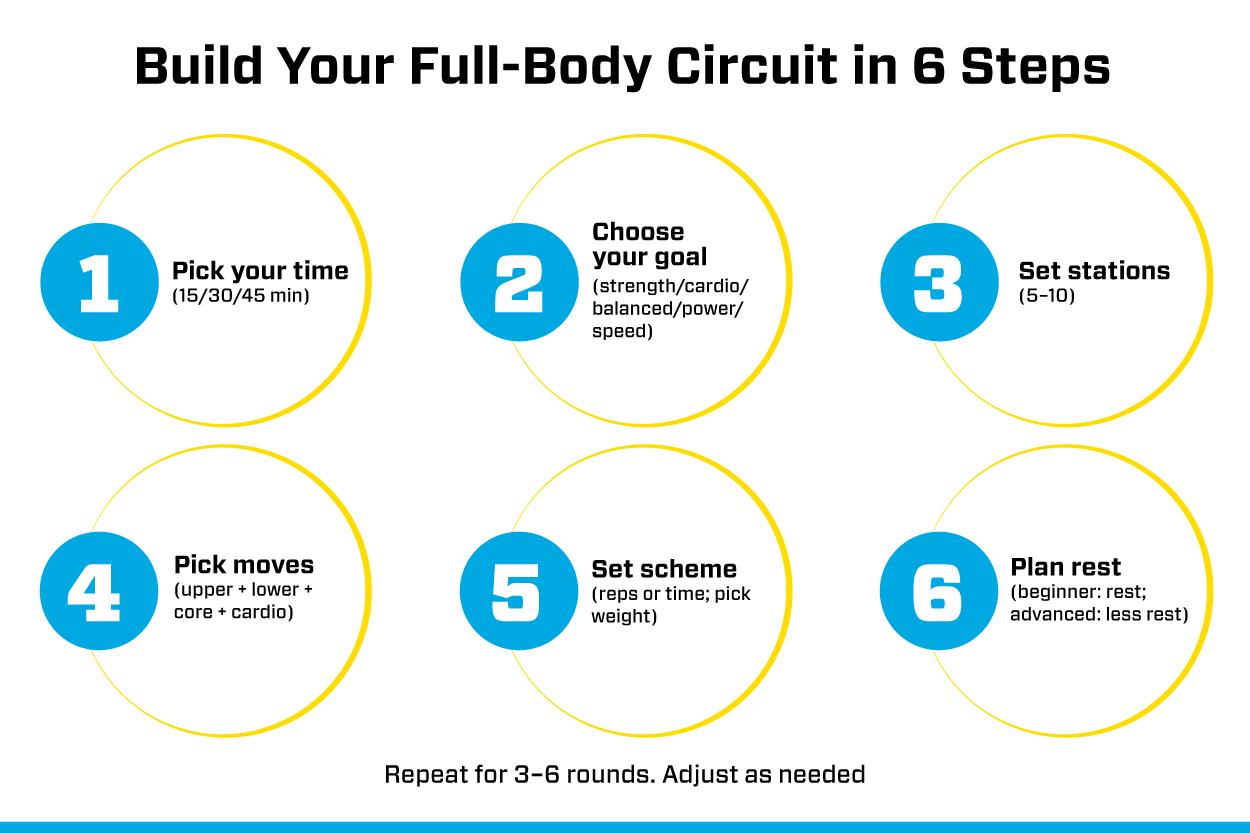
Step 1: Choose Your Workout Duration
How long do you want your circuit training workout to be? Most circuit training workouts last between 15 and 45 minutes, giving you plenty of flexibility.
Based on your skill level, typical circuit training lengths are around:
- 15 minutes (beginner circuits)
- 30 minutes (moderate circuits)
- 45 minutes (advanced circuits)
Your workout length will help determine how many circuit exercises to include, how many reps to perform and how many circuits to complete.
Step 2: Decide Your Training Focus
Your circuit training workout can focus on different areas of fitness depending on your fitness goals.
A few common circuit workout focuses include:
- Strength training circuits
- Cardio-focused circuits
- Full body conditioning circuits
- Explosive power circuits
Many people prefer full-body circuit training because it balances strength and cardio exercises.
Step 3: Choose Your Circuit Exercises
Now it’s time to build your circuit workout routine with the number and types of exercises you want to do. Start by choosing how many different exercises or stations you want to include in your workout. The lower your time domain, the fewer stations you should choose. Most circuits include five to ten stations.
Next, choose the exercises that will make up your workout. Do you want to do a circuit workout with weights? Do you want to focus on specific exercises or a full-body workout? For a full-body circuit workout, include a mix of upper-body, core and lower-body movements to create a balanced gym circuit workout.

Step 4: Choose Reps or Time Intervals
Your circuit training workout is almost complete. Now that you have the exercises you want to perform, figure out how many reps you want to complete during each circuit. It’s usually better to add a time domain rather than a specific rep count for certain exercises, such as 30 seconds of jumping rope. You’ll also need to figure out the weight for any resistance exercises. Choose a rep scheme that feels challenging, but still allows you to complete each circuit with good form.
Step 5: To Rest or Not to Rest?
Depending on your fitness level and the intensity of your circuit workout, you may want to add a minute or two of rest between circuits so your muscles, heart and lungs can recover. Based on your experience level, you can structure rest periods like this:
- No rest between exercises
- 30 seconds rest between stations
- 60–90 seconds rest between circuits
Beginners should consider adding rest time, but more advanced exercisers can make their circuit workout more difficult by skipping rest periods.
SAMPLE CIRCUIT TRAINING WORKOUTS
Need a little help getting started on your first circuit training workout? Here are four circuit workouts you can try at the gym or at home.
Cardio Circuit Training Workout (for Gym)
- 20 walking lunges
- 15 burpees
- 1 minute on the stair step machine
- 1 minute on the rower
- 30-second sprint
- Rest for one minute between circuits
Perform 3 to 6 rounds
Strength Circuit Workout (for Gym)
- 20 chest presses at moderate weight
- 20 hanging knee raises
- 20 bent-over rows (with barbell or dumbbells) at moderate weight
- 20 kettlebell swings at moderate weight
- 10 pullups or deficient pushups
- 10 back squats with moderate weight
- Rest for one minute between circuits
Perform 3 to 6 rounds
Full Body Circuit Routine (for Gym)
- 15 burpees
- 20 bent-over flies with moderately heavy dumbbells
- 30 mountain climbers
- 10 front squats with moderate weight barbell (substitute with goblet squats with dumbbell or kettlebell)
- 30 bicycle crunches
- 1-minute jump rope
- Rest for one minute between circuits
Perform 3 to 6 rounds
Bodyweight Circuit Training Workout (for Home or Travel)
- 10 pushups
- 20 air squats
- 30 crunches
- 30 supermen
- 10 dips using the seat of a chair
- 30 seconds of machine-gun drill
- Rest for one minute
Perform 3 to 6 rounds
You can also pair these circuit workouts with a more focused full-body strength training routine if building strength is one of your goals.
WHAT ARE THE BENEFITS OF CIRCUIT TRAINING?
Is circuit training something you should add to your fitness routine? There are lots of benefits to building an exercise circuit, including:
- Time-Efficiency: Circuit training workouts are designed to be performed quickly and efficiently. Many circuit workouts can be completed in 30 minutes or less, making it easy to fit exercise into your day.
- Get a Full Body Workout: Including the right exercises in a full-body circuit training routine helps you hit all your major muscle groups while improving your cardiovascular health.
- Beginner-Friendly: Circuit training workouts are among the best tools for beginners because they are easy to program and can incorporate exercises at nearly any level. You can also add rest periods between circuits and begin with a low number of reps per exercise.
- Exciting and Challenging Workouts: Since a circuit training routine is so versatile, it’s hard to get bored. You can easily spice up your routine by adding new circuit exercises or changing the workout structure.
- Do Them Anywhere: Can’t make it to the gym? Not a problem. By using bodyweight exercises or everyday items (like chairs and walls), you can perform circuit training workouts at home, in hotel rooms or even in your office (though you may want to bring a change of clothes).
- Easily Adaptable: As you become more experienced, it’s easy to adapt your circuit training workouts to keep them challenging and keep your body improving. By adding more reps, increasing intensity, using more complex exercises, adding more circuits or reducing rest, you can always make your circuit workouts more difficult.
Circuit training workouts offer one of the most flexible and efficient ways to train. With the right exercises and structure, circuit training can become one of the most effective tools in your fitness routine.

START BUILDING YOUR NEXT CIRCUIT WORKOUT
You now have all the tools you need to try your very first circuit training workout or to create your own customized circuit training routine. As you get more comfortable with the circuit training formula, start experimenting with new exercises and formats. The goal is to keep challenging your body so you can continue progressing.
If you want help designing the best circuit workouts for your fitness level, working with a personal trainer can make a big difference. Our certified personal trainers can help you create a personalized circuit workout plan and learn the proper techniques to perform each movement safely and effectively.
If you’re not a member yet, try our 7-Day free trial and take advantage of our Welcome Workout to learn how to use the equipment and build a circuit training routine.
FAQs ABOUT CIRCUIT TRAINING
How many exercises should be in a circuit?
Most circuit training routines include five to ten exercises per circuit, though the exact number depends on your workout length and intensity. You can perform each exercise for a specific number of repetitions, time or even a specific distance.
Is circuit training the same as HIIT?
Circuit training is not the same as HIIT. HIIT focuses on short bursts of intense activity followed by brief rest periods, while circuit training moves through a series of exercises with minimal rest in between, like our Fitness Unchained class formats.
Is circuit training good for weight loss?
Circuit training is effective for weight loss as it combines resistance training and cardiovascular exercises to maximize calorie burn and enhance overall fitness. It’s also a flexible and accessible option, since you can choose the exercises to do in each session.
What are the best circuit exercises for weight loss?
The best circuit exercises for weight loss are high-intensity and strength-based, including burpees, battle ropes, squats and kettlebell swings. Remember to keep your rest periods short in order to maintain an elevated heart rate and help you burn more calories.